Welcome to Connecting Writing Centers Across Borders!

Writing center people enjoy writing—and writing about writing, about writing centers, and about tutoring writing.  That’s one reason why we’re starting a blog so that people all over the globe can interact, post comments, offer useful information, ask questions, comment on each other’s posts, tell us about conferences others might want to attend, list websites where you found information that helps you and your tutors and/or teachers, and so on. Another reason is that in most cases, writing center people are the only ones doing such work at their institution. That can be a bit lonely. So we have to reach across borders to meet each other. This blog will provide the space to do that if you read and post on it.

Continue reading

Posted in Information | Tagged , | Leave a comment

CFP: Symposium Supporting English Writing Competencies, March 27-28, 2014 (Lueneburg, Germany)

The one and a half day symposium “Supporting English Writing Competencies: The Role of Writing Centers in Second Language Learning” at Leuphana University, Lüneburg, March 27-28, 2014, focuses on different organizational structures for L2 writing support within European universities and provides the opportunity for professionals to exchange L2, and particularly English composition teaching practices.
 
We will provide a forum for writing center personnel (professional staff and students tutors/consultants), lecturers and faculty in foreign language departments, lecturers and faculty who teach in English or other languages in an L2 context, non-university affiliated second language specialists, university administrators and staff, and those interested starting a writing center. We particularly invite colleagues who address writing competencies in L2 contexts other than English.
There are two ways to present your work at the symposium:
 
1. Poster Session
We welcome 250-300-word poster proposals for an interactive poster and networking session on Friday afternoon. Possible topics include:
·      Program development at your ESL/L2 writing center
·      The role of ESL/L2 writing competencies within your institution and department
·      Research projects on writing competencies in an ESL/L2 context
·      Teaching strategies/techniques that emphasize academic writing in ESL/L2 contexts
·      Composition support for discipline-specific genres
·      Interdisciplinary academic writing
2. Presentations
We invite proposals (500 words maximum) for 15 minute presentations with 10 minute questions and answer sessions on best practices for L2 composition support. Possible topics include:
·      Writing Center pedagogies
·      Writing Across the Curriculum Initiatives
·   Navigating discipline-specific writing conventions such as those found in the natural sciences, social sciences, business, etc.
·   Integrating writing in foreign language classrooms/centers Using online tools for in-class peer feedback and opportunities for teaching ESL/L2 writing online
·   Writing skills in English for Academic Purposes
Deadline for Submission: January 24, 2014, midnight (CET), to writingcompetencies@leuphana.de
Posted in CFP, Conferences | Tagged , | Leave a comment

CFP: New collection on writing research & pedagogy in the MENA region

As Composition Studies and related disciplines make a “global turn,” there is an increasing need for research into post-secondary writing practices and pedagogy in the Middle East-North Africa (MENA) region. Scholarship emerging from this region needs to be shared globally, as it will shape how writing centers, writing programs, and WID/WAC initiatives – in the region and outside of it – will respond to the increasing globalization of higher education, as well as to international discussions about World Englishes and other language varieties and translingual approaches to writing and writing pedagogy.

In order to address these needs, the editors seek 300-word chapter proposals for a multi-authored volume, tentatively titled Writing Research and Pedagogy in the MENA Region, for anticipated publication in the Parlor Press/WAC Clearinghouse’s book series, International Exchanges on the Study of Writing.

The editors welcome proposals in English revolving around institutional policies and practices, writing pedagogies, and/or actual writing practice(s) in the MENA region. Proposed chapters should take evidence-based, theoretically grounded approaches with research methods sufficiently articulated and adequate for the research questions. All proposals will be considered; however, the editors are particularly interested in proposals that address any of the following questions:

  • How is writing – in English or in other languages – defined and/or valued in the MENA context? How might these definitions or values be attached to the diverse historical, linguistic, social, political, and/or religious contexts of the MENA region?
  • In the MENA context, where there are often three or more languages or varieties of language to consider, how are conventional notions of L1/L2 complicated in relation to writing practices and pedagogy?
  • What are the unique challenges and benefits faced by writing program and/or writing center administrators in the MENA context?
  • What can be learned about writing pedagogy and/or practice from the student and/or faculty populations at various institutions of higher education in the MENA region?
  • In what ways is the interdisciplinary nature of writing being addressed in the MENA region? How have Writing in the Disciplines (WID) and/or Writing across the Curriculum (WAC) initiatives been implemented and/or received in the MENA region, and what can be learned from the successes and/or failures of these efforts?
  • What can literacy scholars learn about writing practices and pedagogies from research in the MENA region? What new questions about writing arise when considering this regional context, and how might these questions be best addressed/approached by scholars in and outside of the region?
  • What do our answers to the questions above, and our experiences on the ground, suggest about course design, curriculum planning, and/or program development in both international and U.S. contexts?

Submission details:

Deadline for proposals is March 1, 2014 (300 words). Full chapter submissions will be due September 1, 2014 (5,000-6,000 words). Only original work not previously published and not currently under review elsewhere will be considered. Please send your submission to all three of the editors: Lisa Arnold, [email protected]; Anne Nebel, [email protected]; and Lynne Ronesi, [email protected].

PDF version of the CFP

Posted in CFP | Tagged , , , | Leave a comment

November/December Issue of WLN Features International Perspectives

The current issue of Writing Lab Newsletter, which should be reaching subscribers now, includes several articles of interest to the international writing center community.

In “Going Global, Becoming Translingual: The Development of a Multilingual Writing Center” (1-6), Noreen G. Lape discusses the need for centers to recognize that many students work in multiple languages.

Marna Broekhoff reviews Changing Spaces: Writing Centres and Access to Higher Education, a new book by Arlene Archer and Rose Richards that discusses writing centers in South Africa (7-9).

Finally, Helena Wahlstrom reflects on her experiences tutoring in a second language in “Imposter in the Writing Center-Trials of a Non-Native Tutor” (10-13).

If you do not yet subscribe to WLN, you can check out this issue’s tutor’s column online:  “From Symbols to Stories: Helping Students Make Personal Connections,” by Elizabeth Dellinger.

Posted in Uncategorized | Leave a comment

CFP for MENAWCA 2014 Conference

The conference theme is “Sustaining Writing and Writing Centers in the Middle East-North Africa Region.”

As writing centers grow in the MENA region, questions emerge not only about how to sustain and develop them but also about how they can serve as model centers. What strategies can and should regional writing centers adopt in order to establish a solid presence within institutional frameworks? How can peer tutors, international collaborations, local/regional research initiatives drive the momentum? What alliances within or across academic institutions strengthen writing center continuity and support? What technological initiatives, including use of mobile devices, influence our effectiveness with student writers and as we network with other centers? What theories and practices that grow out of local contexts can promote writing center work both within the MENA region and with other local, regional, and international writing forums? This conference aims to identify multi-faceted variables that promote the sustainability of writing programs, writing centers, and most importantly the dialogue between writers.

The MENAWCA invites students, teachers and other professionals who support student writers to its biennial conference, November 7-8, 2014 at the Canadian University in Dubai.

Deadline for Submissions: April 15th, 2014

Continue reading

Posted in CFP, Conferences | Tagged , , , | Leave a comment

Spinning the Plates in a Writing Center

Like Spinning Plates

Image credit: used under rights permitted by Jameson Gagnepain at Flickr

This post began as a reply to Jared Odd, the Writing Center Director at Lindsey Wilson College. Professor Odd wrote to the national e-list for Writing Across the Curriculum, asking for advice about managing a Fellows-based program at small colleges. At times, such as our current semester, I feel like one of the performers who keeps about 30 fragile plates spinning on the ends of skinny poles.

Richmond’s program for what we now call “Writing Consultants” now enters its 21st year. How we have managed has become a little more daunting recently, with only 3,200 undergraduates and the need to staff 50+ sections with Writing Consultants while keeping a Writing Center open. My post covers a few bedrock principles and recent challenges.

  • The Training Class Must Be Strong: We don’t shortchange Consultant training at Richmond. All of them must complete a semester-long course, Eng. 383, that is by invitation of our faculty. I could rush through 100 new Consultants in a couple of weeks of basic training, but I fear they’d be unethical editors, fixing writers’ problems but not making them better writers. Faculty would consider the help intellectually lacking, and I’m not about to dumb-down our commitment to fundamental ideas of peer work, long established in the field and tested well in our program. I find that recruiting my 36 new Consultants each year, 18 trained each semester, can staff the program. This has worked well at the similar-sized program at Swarthmore, long a model for WAC at Richmond. Except…
  • The Busy Student Body Must Notice Us: It is hip to be stressed out and over-committed on this campus. Strike one for staying on student radar, as a program or potential employer. Study abroad, a wonderful opportunity that I want every student to experience, has gradually become nigh universal for our first-semester juniors. Strike Two. Then there are internships, independent study, summer research, the hum of non-academic but seemingly essential social obligations…Strike Three. For these reasons, over time, more and more students delayed taking Eng. 383 until their third or even fourth years. Having sown this wind for a few years, in May 2013 I reaped the whirlwind, finding about 20 of our trained Consultants walking across the stage in their caps and gowns. Then, this term, another 15 went abroad. Thus we are scrambling to staff 50+ sections and keep the Writing Center open with 37 Consultants. Usually, I employ 50.
  • The Director Must Appeal to Potential Consultants Early and in the Right Way: My doubling-down on recruitment began early this semester. I notified faculty teaching first-year seminars that a crisis was at hand; I would depend upon them to bring me more first-and-second-year recruits. So far, a few are drifting in, but I will appeal as well to the students directly. Paying Consultants well helps, but students want more than a job today. Students at Richmond want a path to a post-collegiate career or graduate school. Working as a Consultant here means a better chance of landing a graduate assistantship or job with a communications focus. I count EBSCO, Penguin, and The National Archives among the employers of recently graduated Consultants.
  • Faculty in all Fields Must Become Partners: I have never felt that putting a writing program in a “silo” works well. First of all, writing has historically been under-staffed and under-underfunded. Susan Miller’s “sad woman in the basement” was more than a brilliant metaphor in her book Textual Carnivals. It was the fact on the ground (and beneath the ground) for a long time. Now that the Humanities themselves are in national crisis, writing programs cannot necessarily count on English departments with diminishing institutional clout for support. Program directors will need to sit down with Mathematicians and Economists and Sociologists, too, to determine local needs, priorities, and resources. These faculty will also serve as recruiters for those new student employees to keep WAC efforts vital.

I remain convinced, after more than two decades doing this work (with some very pleasant side trips into educational technology, the design of simulations, and more) that writing programs will thrive because our colleagues and administrators share our concern, if not necessarily our values, about writing instruction. The Director’s job, as the public face of writing on campus, is to be certain that the “center remains in the Center,” or wherever else writing instruction is housed currently. My greatest fear is that other units of a college or university, hungry for influence and budget, could gobble up WAC and Writing Centers.

We should not let that happen, since with merger may come a pedagogy we have worked so hard to avoid in our teaching and tutoring.

Posted in Advice | Tagged , , , , , , , | Leave a comment

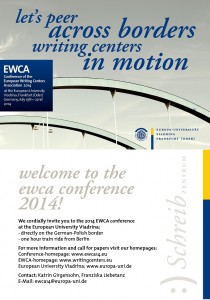
Invitation to EWCA conference 2014 in Germany

Dear colleagues,
We cordially invite you to the 2014 EWCA conference at the European University Viadrina in Frankfurt (Oder)/Germany

Let’s peer across borders – writing centers in motion

July 19th-22nd 2014

-          Directly on the Polish border

-          One hour train ride from Berlin

postcard ewca 2014 conferenceWe would like to invite you to peer into the future of writing centers in Europe and worldwide. During the last years, many things came into motion with regards to writing centers and writing pedagogies: New centers opened, new literacies became vital, new research areas became important, new collaborations started. Our 2014 conference aims to offer a space for peering into the work of others and for starting new collaborations in research and practices. The verb “to peer” indicates that we invite everybody to consider our everyday work and to take a scholarly stance. It also reminds us of peer learning and a truly collaborative learning experience. To ensure exciting and lasting networking across borders we invite research-based presentations, workshops, and poster presentations, but will also offer an open space session and possibilities to meet with special interest group

The conference lingua franca will be English. However, please feel free to offer your sessions also in Polish, French or German.

Please find  the call for papers at the conference homepage: www.ewca14.eu.

We are looking forward to meeting you in July 2014!

Best wishes,

Katrin Girgensohn

Posted in CFP, Conferences | Tagged , , | Leave a comment

Handbook for writing in the disciplines: Music

musicindex

Our Writing Consultants Lauren Oddo and Kelsey Shields prepared a handbook with the cooperation of music faculty and our music librarian. Have a look for advice to writers, a sample essay, as well as transcripts of interviews with faculty at this URL:

http://writing2.richmond.edu/writing/wweb/music/

Posted in Resources | Tagged , , , , | Leave a comment

Three Professors In English Discuss Effective Writing

We just uploaded interviews with three professors in our English Department:

http://writing2.richmond.edu/writing/wweb/english/  (see left hand menu for links to videos).

Our Writing Consultants conducted these interviews. They may load slowly, as they are locally hosted. We have about 30 more in various fields. See the handbooks linked from this page:

http://writing2.richmond.edu/writing/wweb/disciplines.html

Our long-term goal is to compile interviews for each handbook, as well as sample papers with commentary by the professors and writers (including some reflective “what if” remarks).

Posted in Resources | Tagged , , , , , , | Leave a comment

Reminder: Deadline for Winter AEQ Issue Approaching!

The Deadline for submissions to the Winter 2013 Issue of Academic Exchange Quarterly is the end of August!

Articles for the Special Section on Writing Center Theory and Practice may explore issues of theory, practice, and experience in writing center work, including qualitative and empirical studies and discussions of pedagogy. 

For more information, please visit http://rapidintellect.com/AEQweb/center2.htm.

Posted in CFP | Leave a comment

Going International: Stories of Second Language Writers

In the last three years, the writing center that I direct at Dickinson College has become a Multilingual Writing Center, or what we here like to call the MWC. Yes, we work with ELL writers who come from varied and multiple language backgrounds. However, we call ourselves “multilingual” because we have undergraduate peer writing tutors in eleven languages. In AY 2011 we had over 800 visits; in AY 2012 over 1200 visits, and in AY 2013 over 1500 visits. The MWC, I think, is here to stay and students are loving it.

As you might imagine, the MWC has created a lot of pedagogical and theoretical challenges. For one, I no longer think of tutoring quite so hierarchically (higher and lower/later order concerns). Instead, we use the phrase “holistic tutoring” in our writing center. For another, my college has a robust study abroad program with students coming here and going to international sites in droves every year. That said, I have become very interested in intercultural rhetoric and cultural varieties of academic writing. In trying to think about academic discourse communities along global lines, I have begun to interview the students who have just come back from study abroad or are studying abroad at Dickinson. I have made these interviews into podcasts. I invite you to visit my site, “Going International: Stories of Second Language Writers” — http://blogs.dickinson.edu/mwc/

In the meantime, of those writing centers out there that call themselves bilingual or multilingual, how do you find your pedagogy changing? How do you take into account cultural differences related to writing and the writing process?

Posted in Uncategorized | Leave a comment